Ever seen a distribution wag its tail?
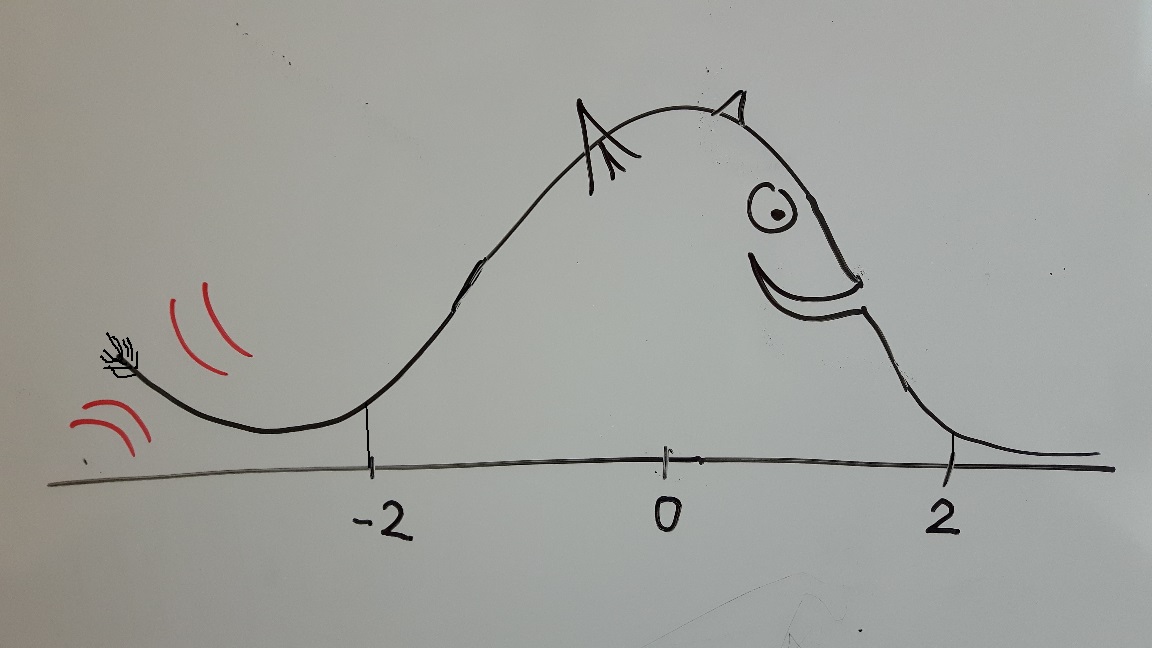
Some believe that extreme good luck (or bad luck) is a fact of life. A hot streak in football, baseball or soccer would be a good example. Sometimes you are on a hot streak … sometimes you are not.
The extreme outcomes caused by such streaks have their analogue in financial markets: you could face an extreme positive or negative return. Does the probability of such extreme outcomes vary over time. In other words: could there be streaks of negative returns (and thus a large negative compounded extreme negative return) at some times, but not at others.
In our paper entitled “Time-varying tail behavior for realized kernels”, Andre Lucas and myself look into the time variation of extreme financial stock returns. We go beyond many of the standard literature in that we do not only make risk time-varying, but also extreme risk. Technically, this means we allow the tail behavior of a distribution to move over time, not unlike a dog wagging its tail up and down. Using our new machinery, we find evidence that indeed extreme outcomes are more likely during some times than others, as our model beats a number of modern benchmarks in a forecasting contest.
The upshot of all of this is that extra risk controls may be in order in situations where not only standard risks are high, but extreme risk probabilities are high as well.
Download the paper:
Opschoor, Anne, Andre Lucas (2019): “Time-varying tail behavior for realized kernels”, Tinbergen Institute Discussion Paper 19-051/IV.
Picture and text: Andre Lucas
Can stock market correlation dynamics be captured by a single factor, or: can Andre sketch a monkey? No. And no.

Suppose I show you a picture of a monkey. Of course, if the picture is a coarse sketch, you get the rough idea, but miss many of the details. If I show you a photo instead, you get all the details and corresponding wonder.
Taking a picture (at least for me) is much easier than making a sketch. However, when modeling many stock prices simultaneously, constructing a fully detailed picture is hard, particularly if we want to show how risk properties of stocks (or other assets) move together over time. When does the dependence between different parts of the market cluster together, and what risk build-up does this entail? Because of the complexity of this dynamic modeling problem, researchers so far have regularly resorted to simple, coarse models: so-called single-factor dynamic copula models with time-varying loadings (sorry for the bit of jargon here). The gist of it: with a coarse model, we get at a least the main movements right, we hope.
In our paper entitled “Closed-Form Multi-Factor Copula Models with Observation-Driven Dynamic Factor Loadings”, Andre Lucas, Istvan Barra, Dick van Dijk and myself show that to model the full dependence dynamics in large markets with many assets, a photo rather than a sketch is useful and required. In particular, we not only need to model the broad market movements, but also the intra-industry risk dynamics and their cross-industry spill-overs to get a good impression of all aspects of risk.
The new model we provide is computationally tractable, even with many factors. It is quick to compute (due to the use of our favorite score dynamics), and scalable to high dimensions. Computational complexity thus no longer seems a reason to stick to a simple model. Using US stock market data we illustrate that our model works well in-sample and out-of-sample if we consider all aspects of risk (i.e., the entire outcome distribution). If instead we concentrate on a specific single aspect of risk, namely the riskiness of the investment portfolio with minimum variance, a coarse (one-factor) model can capture this single risk aspect adequately, as expected, but not all other risk aspects at the same time.
The summary of it all is twofold. No: a single factor model with dynamic loadings is insufficient to describe all correlation dynamics in large asset markets. And no: Andre may have some skills in constructing factor models with dynamic loadings, but he is definitely no good at sketching monkeys.
Download the paper:
Opschoor, Anne, Andre Lucas, Istvan Barra, and Dick van Dijk (2019): “Closed-Form Multi-Factor Copula Models with Observation-Driven Dynamic Factor Loadings”, Tinbergen Institute Discussion Paper.
Picture and text: Andre Lucas
The strong persistence in (realized) dependence for stock prices can help for forecasting at longer horizons
Stock prices typically move together. For instance, two stock prices can be affected similarly by common news about the industry they are in, or about the local or global economy. Different methods have been proposed to describe this time variation. A recent method that appears to work well in many settings exploits stock price variations within the day: for instance, every minute, or even more frequent. At such high frequencies, the dependence between stock price movements is typically very persistent: the dependence structure found on one day has quite a long lasting relation to the dependence structure on future days.
In our paper Fractional Integration and Fat Tails for Realized Covariance Kernels, which has been accepted by the Journal of Financial Econometrics, Andre Lucas and Anne Opschoor (me) address the question whether this strong persistence can actually be exploited for longer term forecasting. The short answer is: yes. Even though the information underlying the measurements of dependence is on a minute-by-minute frequency, the resulting measurements can be helpful at horizons as long as up to one month. The tools needed for this have to account for many of the features of stock prices and stock price dependence, such as erratic big price movements (fat tails), changing market nervosity and uncertainty (time-varying volatility), and the strong persistence due to the high-frequency underlying measurements. All of these tool features are needed, but at different periods in time. Whereas accounting for changing market nervosity is always important, correctly accounting for erratic big price movements is particularly relevant during crises, and accounting for strong persistence is important during calmer episodes. Previous methods did not account for all of these features simultaneously in a coherent way.
You can download the paper here.
Treat outliers for risk models with due care!
Risk managers, pension funds, asset managers and banks nowadays use advanced models to assess the risk of investment portfolios. Much scientific progress has been made over the past decade to develop new techniques to measure the risk of such portfolios. In recent years scientists and professionals have started to use so-called high-frequency data to measure the risk. High-frequency data are frequent measurements of for instance stock prices or exchange rates. You can think of measurements every minute, every second, or in some cases even every millisecond. Such measurements often result in more accurate risk assessments than traditional daily measurements.
An important issue, however, is how to deal with so-called outliers in high-frequency data. An outlier is an anomalous measurement in the data. Think of a temporary crash in markets due to a faulty algorithm, a typo by a trader, or any other reason. Such anomalous events occur more often than you would think. For instance, in May 2010 there was a famous flash-crash than unsettled the main U.S. financial markets. Within the time span of 36 minutes, the Dow Jones index droped by 9%(!!) and subsequently recovered. Such big swings within the day result in enormous swings in risk measures and incorrect risk forecasts for subsequent days.
Anne Opschoor (me), Andre Lucas , Pawel Janus, and Dick van Dijk have developed a new technique to deal with such anomalous observations in high-frequency data. Our paper New HEAVY Models for Fat-Tailed Realized Covariances and Returns has been accepted in the Journal of Business and Economic Statistics. The core novelty of our approach is that anomalous event do not automatically inflate risk forecasts as in traditional models. Instead, the model trades off whether the increased risk is due to a true increase in risk, or to an incidental, anomalous event. We use statistical techniques calibrated on financial data to properly make this trade-off.
We test the model on a long time series of 30 U.S. stocks over the period 2000-2014. During that period, we have seen big events like the financial crisis of 2008, but also peak events like the May 2010 flash-crash. Using the new techniques, risk forecasts are significantly better than with the most recent competing methods. Moreover, our method is relatively straightforward to implement, which should increase its potential impact.

